Emotional Mastery in Sport: Unlocking Stronger Athlete Leadership
Key Points
Emotional intelligence (EI) is the ability to recognize, regulate, and use emotions effectively—crucial in high-performance sport.
Athletes with higher EI perform better under pressure, lead with empathy, and foster stronger team cohesion.
Emotional regulation helps athletes turn pressure into composure, making it a competitive edge—not just a “soft skill.”
Mental performance strategies like breathwork, affect labelling, empathy, and rituals train emotional mastery for peak performance.
A Mental Performance Coach helps athletes develop emotional tools for leadership, teamwork, and resilience under stress.
What to Consider When Reading
Do you treat emotions as something to suppress—or as tools to train and use for performance advantage?
Reflect on how you or your athletes handle emotional spikes during competition. Could those moments be more intentional?
When you think of leadership in sport, what comes to mind? Grit, discipline, physical dominance, maybe even charisma. But there’s another quality quietly shaping champions: emotional intelligence (EI).
Emotional intelligence isn’t about being “emotional” — it’s about being aware, regulating emotions under pressure, and using emotions as tools for stronger leadership and performance. In high-performance sport, this can be the difference between losing composure and stepping up as the leader your team needs.
Think about it: the discipline you’ve built in training is physical, but the mindset advantage comes from how well you can manage your emotions — on the days when you’re frustrated, when you clash with a teammate, or when the score isn’t in your favour.
What is Emotional Intelligence? (H2)
Psychologists Peter Salovey and John Mayer (1990) first defined emotional intelligence as the ability to recognize, understand, regulate, and use emotions effectively. Daniel Goleman (1995) popularized the concept, breaking it into five key domains:
Self-awareness – recognizing your own emotions
Self-regulation – managing emotions, especially under stress
Motivation – channelling emotions toward goals
Empathy – understanding others’ emotions
Social skills – building and maintaining relationships
In sport, these skills go beyond theory. They shape how athletes respond to high-pressure situations, support teammates, and even influence referees, coaches, and fans.
Why Emotional Intelligence Matters in Sport (H2)
Research shows that emotional regulation is directly linked to better athletic performance. Laborde, Dosseville, and Allen (2016) found that athletes with higher emotional intelligence demonstrated greater resilience, decision-making, and teamwork under pressure.
Why it matters:
Better teamwork: Athletes who can empathize and communicate clearly reduce conflict and strengthen group cohesion.
Sharper decision-making: Instead of letting frustration cloud judgment, emotionally intelligent athletes can reset quickly and focus on the next play.
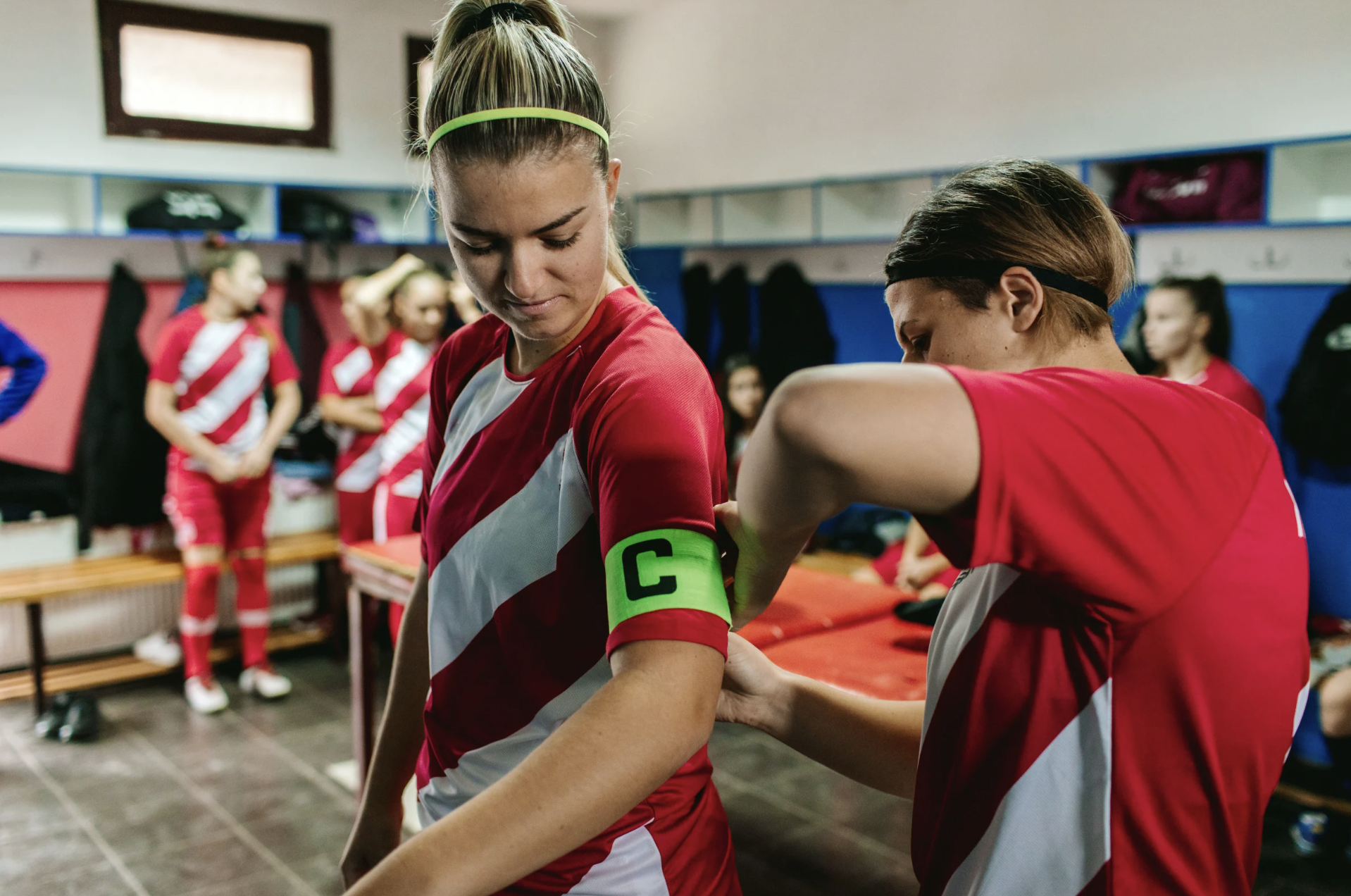
Leadership: A captain who remains composed under pressure sets a confident example for the entire team.
As NBA legend Magic Johnson once said:
“Ask not what your teammates can do for you. Ask what you can do for your teammates.”
That attitude starts with emotional awareness.
Real-World Examples of Emotional Intelligence in Action (H3)
Serena Williams: Known for her fierce intensity, Serena has also spoken openly about emotional control on court. In interviews, she has described the importance of channelling frustration into focus, a key form of emotional regulation.
Lionel Messi: Unlike flashier leaders, Messi leads quietly through composure and empathy. His ability to stay calm, connect with teammates, and build trust is often credited as much as his technical brilliance.
Michael Jordan (The Last Dance): While Jordan was hyper-competitive, his self-awareness allowed him to use anger as fuel rather than a distraction, helping him dominate high-pressure moments.
These athletes didn’t just master skills — they mastered their emotions as well.
Building Emotional Mastery: The Key to Teamwork and Competitive Edge
Emotional awareness is the foundation of stronger teamwork. When athletes can identify and regulate their own emotions, they’re less likely to let frustration spill over into conflict with teammates or make poor in-game decisions. Research indicates that athletes with higher emotional intelligence exhibit stronger communication, greater trust, and increased cohesion within their teams (Laborde et al., 2014).
On the competitive side, emotional awareness becomes a secret weapon. A player who can recognize rising anxiety before a penalty kick, or channel excitement into focused energy at the start of a race, gains control where others might lose composure. For leaders, this means reading teammates’ emotions in real time — knowing when to push, when to support, and when to steady the group.
Tennis legend Serena Williams has often credited her ability to stay composed under pressure as key to her dominance. In interviews, she has emphasized that “emotions can be your biggest weapon or your greatest weakness” — highlighting how regulating frustration and turning nerves into focus gave her an edge in close matches (Clarke, 2019).
Similarly, as NBA champion LeBron James once said about handling high-stakes moments: “You can’t let yourself get too high or too low. You’ve got to stay even-keeled, trust your teammates, and focus on the next play” (McMenamin, 2018). His words capture the balance of self-regulation and team connection that defines emotionally intelligent athletes.
When emotional awareness is trained alongside physical skills, it becomes both a team asset and a competitive advantage — helping athletes not only perform better individually but also elevate everyone around them.
Building Emotional Mastery: A Playbook for Athletic Leadership
So, how can athletes develop emotional intelligence and leverage it into effective leadership on the field, court, or track? Here’s a playbook — backed by psychology and lived out by some of the best in sport.
1. Check Your Pulse — Serena Williams Style
After a tough point, instead of slamming a racquet, Serena Williams often takes a second to pause, breathe, and acknowledge the frustration before resetting. Research shows that simply naming what you feel (“I’m tense,” “I’m frustrated”) reduces its intensity (Lieberman et al., 2007). Think of it as taking your emotional temperature before it spikes.
2. Breathe Before You React — Like Russell Wilson in OT
NFL quarterback Russell Wilson is known for his calm in high-pressure situations. One of his go-to tools is controlled breathing — techniques like box breathing (inhale 4, hold 4, exhale 4, hold 4). This type of breathing triggers the parasympathetic nervous system, shifting your body from a “fight-or-flight” state to a state of “cool and collected.”
3. Practice Empathy in Team Settings — The LeBron Assist
Emotional intelligence isn’t just inward; it’s outward. LeBron James is famous not only for highlight dunks but for how he reads teammates’ moods. A pat on the chest, a quick “we got this” after a turnover — these micro-moments boost team morale. Even science backs it: athletes high in empathy foster stronger cohesion and trust (Laborde et al., 2014).
4. Reframe the Moment — Michael Jordan’s “Next Play” Mindset
MJ missed more game-winning shots than he made, but he always reframed his failures as valuable feedback. Instead of spiralling into self-doubt, he treated missed shots as information for the next possession. This mindset shift prevents emotions from dragging down performance and helps athletes stay focused.
5. Ritualize the Reset — Steph Curry’s Free-Throw Dance
Rituals aren’t superstition; they’re emotional reset buttons. Steph Curry spins the ball, dribbles twice, and exhales before every free throw. That tiny routine signals his brain: “block out the noise, focus on the shot.” Whether it’s bouncing a tennis ball, adjusting gloves, or using a personal mantra, rituals give athletes control over chaotic moments.
Where a Mental Performance Coach Comes In
A Mental Performance Coach (MPC) can help athletes unlock their emotional toolkit:
Awareness training: Helping athletes recognize emotional triggers.
Regulation strategies: Utilizing teaching techniques such as self-talk, mindfulness, and breathing exercises.
Leadership development: Building empathy and communication skills for captains and leaders.
Confidence building: Turning emotions into a source of power rather than pressure.
In sport, emotions aren’t weaknesses to suppress — they’re tools to master. The athletes who win consistently aren’t the ones who never feel pressure, but the ones who know how to channel it.
Emotional intelligence is the hidden superpower that separates the good from the great in sport. Master it, and you won’t just play harder — you’ll lead stronger.
References
Clarke, L. (2019, July 13). Serena Williams and the power of emotional control. BBC Sport. https://www.bbc.com/sport/
Goleman, D. (1995). Emotional Intelligence: Why it can matter more than IQ. Bantam Books.
Gross, J. J. (2015). Emotion regulation: Current status and prospects. Psychological Inquiry, 26(1), 1–26. https://doi.org/10.1080/1047840X.2014.940781
Laborde, S., Dosseville, F., & Allen, M. S. (2016). Emotional intelligence in sport and exercise: A systematic review. Scandinavian Journal of Medicine & Science in Sports, 26(8), 862–874. https://doi.org/10.1111/sms.12510
Laborde, S., Guillén, F., & Watson, M. (2014). Trait emotional intelligence and preference for intuition and deliberation: Respective influence on academic performance. Personality and Individual Differences, 65, 45–50. https://doi.org/10.1016/j.paid.2014.01.038
Lieberman, M. D., Eisenberger, N. I., Crockett, M. J., Tom, S. M., Pfeifer, J. H., & Way, B. M. (2007). Putting feelings into words: Affect labelling disrupts amygdala activity in response to affective stimuli. Psychological Science, 18(5), 421–428. https://doi.org/10.1111/j.1467-9280.2007.01916.x
Mayer, J. D., & Salovey, P. (1990). Emotional intelligence. Imagination, Cognition and Personality, 9(3), 185–211. https://doi.org/10.2190/DUGG-P24E-52WK-6CDG
McMenamin, D. (2018, May 28). LeBron James: Staying even-keeled through highs and lows. ESPN. https://www.espn.com/
NBA.com. (n.d.). Magic Johnson quotes. Retrieved August 2025, from https://www.nba.com
Tod, D., Hardy, J., & Oliver, E. (2011). Effects of self-talk: A systematic review. Journal of Sport & Exercise Psychology, 33(5), 666–687. https://doi.org/10.1123/jsep.33.5.666
Wagstaff, C. R. D. (2014). Emotion regulation and sport performance. Journal of Sport & Exercise Psychology, 36(4), 401–412. https://doi.org/10.1123/jsep.2013-0257