Performing While Watched: Handling Attention Without Cracking

Written by: Maria Nita
Key Points
The Spotlight Effect heightens self-awareness in high-pressure leadership moments, often triggering stress and performance disruption.
Reframing Pressure as Fuel helps leaders shift from feeling judged to feeling seen, transforming anxiety into influence.
Mindset Tools like breathing, mindfulness, and trained self-talk build composure and confidence in visibility moments.
Exposure Practice and Coaching can desensitize leaders to pressure, making high-stakes performance feel like second nature.
What to Consider When Reading
How do you typically react when all eyes are on you—does visibility sharpen or shake your performance?
Do you interpret stress signals (e.g., fast heartbeat, tension) as panic or preparation?
Is your self-worth dependent on external validation, or rooted in preparation and values?
What habits or tools help you reset and refocus under pressure—do you have a plan, or do you react on the fly?
Are you practicing exposure to pressure in a way that strengthens your mindset—not just your skill set?
There is something powerful about being in the spotlight. For many leaders, that surge of attention fuels adrenaline, motivation, and focus — the kind that sharpens executive performance when it matters most. However, the same spotlight can also feel blinding. The moment before a high-stakes presentation, major decision, or public evaluation, your awareness heightens — suddenly every move, gesture, and pause feels amplified. This hyper self-awareness, often referred to as the spotlight effect, can shift your focus from the task to yourself, creating a cycle of self-scrutiny and tension. Some thrive under this visibility pressure, while others feel it affects their confidence. The truth is, performing while watched is not about eliminating anxiety — it is about learning to use it. A leadership mindset turns the feeling of being observed from a threat into an opportunity, transforming anxiety and stress into fuel for higher performance.
Understanding the Psychology Behind Visibility Pressure
When you are being observed — whether presenting to a boardroom or leading a team under scrutiny — your brain interprets that attention as a social evaluation threat (Dickerson & Kemeny, 2004). In moments like these, your autonomic nervous system activates, triggering a rise in heart rate, adrenaline, and cortisol. Physiologically, your body is preparing you for optimal performance. However, psychologically, it can feel like something is wrong. Many people misinterpret these sensations — such as a pounding heart, sweaty palms, and shallow breathing — as signs of panic rather than readiness. That is where things start to spiral out of control.
This internal focus shifts your attention away from the task and toward your bodily sensations and fears of being judged. The result is what performance psychologist Roy Baumeister (1984) referred to as choking under pressure: overthinking actions that are usually automatic, which disrupts the smooth, natural execution. The key lies in reinterpreting your body’s stress response — not as a threat, but as fuel. When you understand that your quickened heartbeat is your system preparing you to act with authority, not freeze, you begin to regain control. That top-down awareness — where the mind regulates the body — is the first step to mastering composure in the spotlight. From there, tools like controlled breathing and mindful reframing can help transform the feeling of judgment into one of being seen and heard.
Leadership Mindset Shift: From Being Judged to Being Seen
One of the most powerful mindset shifts a leader can make is moving from the fear of being judged to the confidence of being seen. When eyes are on you—whether in a boardroom, on a stage, or during a key decision moment—it is easy to slip into self-critique, overanalyzing every expression or word. However, visibility is not a threat; it is an opportunity. It is the chance to let your ideas, values, and preparation speak for themselves. Instead of asking “What if they are judging me?” try reframing it as “This is my moment to be heard.”
This shift is deeply tied to self-concept and self-identity. Leaders who depend on external validation often crumble under scrutiny because their self-worth fluctuates with others’ opinions. In contrast, those anchored in self-trust and values perform with composure—they understand that confidence does not come from being liked, but from being authentic. It is built through preparation, experience, and the willingness to learn from and move forward from failures. Every time you have faced pressure and kept going, you have been rehearsing for moments like these. When you reframe visibility as influence—not exposure—you transform attention from something that drains you into something that fuels you.
Tools to Train Your Mind to Make the Shift
1. Regulate Before You React
Before any major presentation or decision, the first step is to regulate your emotions before they regulate you. When you feel watched, your autonomic nervous system can interpret this as a threat, resulting in a spiking heart rate, tension, and elevated cortisol levels. These reactions are not signs of weakness; they are simply your body preparing for action. The key is learning to signal safety back to your system.
Breathing is one of the fastest ways to do that. Box breathing, for example, is a simple yet powerful tool used by athletes, military personnel, and executives. It involves inhaling for four seconds, holding for four seconds, exhaling for four seconds, and pausing again for four seconds. This rhythmic pattern activates your parasympathetic nervous system, helping your body shift out of panic mode and back into a state of focus. When your physiology settles, your thoughts follow, and you can respond with clarity rather than react out of stress.
2. Anchor Your Focus Through Mindfulness
Once your body feels safe, your mind is free to think. A powerful way to quiet the mental noise of self-consciousness is through mindfulness practice. Before a high-stakes meeting or presentation, try anchoring your attention to a single, simple focus point—your breath, a spot on the wall, or even the sensation of your feet on the floor.
When your thoughts start to drift toward “What are they thinking of me?” or “What if I mess up?”, gently redirect your attention back to that anchor point. This trains your brain to stay in the present moment rather than spiralling into imagined judgment. Over time, mindfulness builds the mental endurance needed to remain calm and steady even when eyes are on you.
3. Train Your Inner Dialogue
The way you talk to yourself shapes the way you perform. Self-talk is not just motivational fluff —it is a direct line of communication between your conscious mind and your body. The words you use cue your nervous system, influence confidence, and determine how your brain interprets challenge.
When under pressure, our instinct is often to think in “don’ts”: Do not mess up. Do not forget your points. Do not lose focus. However, your brain does not register the “don’t” — it fixates on the action that follows. Instead, replace restrictive statements with empowering, action-oriented ones.
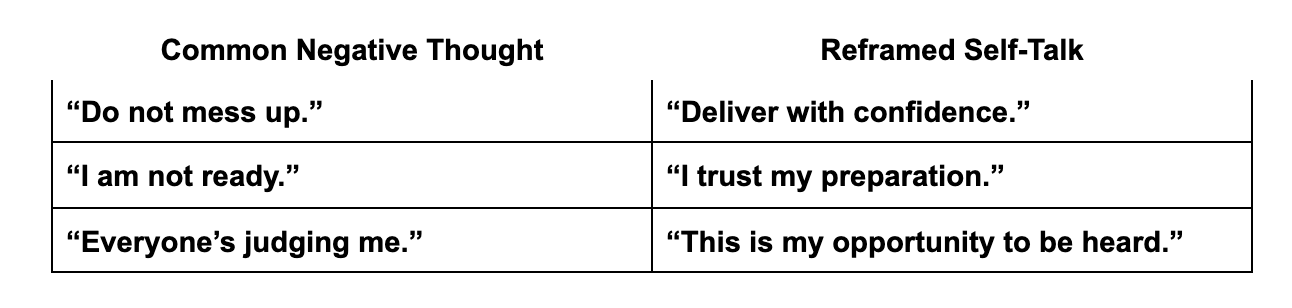
This subtle shift rewires your focus from fear of failure to ownership of your skill set.
Another helpful tool is a “reset word” — a quick cue that grounds you back in the present when your thoughts start to spiral out of control. Words like steady, sharp, focus, or I am here act as micro-triggers for composure and clarity. Just as athletes have pre-performance rituals or trigger words, leaders can use verbal anchors to regain command of their mindset in high-visibility moments.
Example: Former PepsiCo CEO Indra Nooyi has spoken about using brief moments of positive self-talk before major presentations to center herself — reminding her mind that she is prepared, qualified, and ready to lead (Forbes, 2018). Similarly, research from Hardy et al. (2001) shows that structured self-talk enhances confidence and focus under pressure, especially in performance-driven environments.
Positive self-talk is not about pretending everything is fine —it is about training your mind to focus on what is within your control. The more your inner dialogue aligns with your preparation and values, the less space fear and external judgment have to grow.
4. Practicing Exposure to Pressure
Another powerful strategy to strengthen confidence under pressure is exposure. In psychology, exposure is often used to help individuals overcome phobias, fears, or anxiety through gradual and repeated confrontation of the stressor (Craske et al., 2014). The same principle applies to performance pressure — the more we place ourselves in controlled, high-stakes environments, the less intimidating they become over time. Practicing exposure can mean rehearsing a presentation in front of colleagues, mentors, or even friends who make you slightly uncomfortable. The goal is not the approval of others, but to simulate the physical and emotional sensations that arise in challenging moments. By recreating these conditions, your mind and body learn to adapt and regulate under pressure, building a form of “immunity” to stress.
Additionally, inviting constructive feedback during these practice rounds can strengthen your growth mindset and focus on controllable elements, such as clarity, tone, and body language, rather than perceived judgment. Over time, repeated exposure helps reframe high-pressure moments as opportunities for growth rather than threats.
How a Mental Performance Coach Can Elevate Your Presentation Presence
While no coach can do the work for you, a Mental Performance Coach acts as a guide to help you build the psychological tools needed to thrive under pressure. They work to identify your unique emotional triggers and tailor strategies that align with your personality, communication style, and performance environment.
Through one-on-one sessions, a coach can help you refine your self-talk, establish calming routines such as breathing and mindfulness, and visualize confident execution before key presentations or meetings. They can also create simulated “pressure practices” that mirror real-life scenarios, providing a safe environment to rehearse your composure and adaptability.
Over time, this training strengthens emotional regulation and performance consistency, equipping you with a mindset that remains grounded, focused, and ready to respond — no matter the circumstances.
Lead With Calm, Speak With Authority
Your presentation mindset is not built during show time—it is built in every quiet rehearsal, every morning self-talk, and every decision to practice under pressure. When you train your mind as intentionally as you prepare your material, you walk into the room with a focused, clear, and confident presence. In the end, your audience does not just hear your message—they believe in it because you believe in it.

Maria Nita
My passion for sports and mental health grew through years of training, with strength work shaping my resilience, confidence, and discipline. After earning a BA in Psychology from Toronto Metropolitan University, I’ve worked in psychology and trauma clinics, deepening my understanding of mindfulness and the mind-body connection. Alongside this, I coach fitness clients, focusing on both physical and mental well-being. At The Mental Game Clinic, I contribute research blogs on topics like emotional resilience and focus under pressure, and I’ll soon begin my Master’s in Clinical Psychology with the goal of becoming a Certified Mental Performance Consultant (CMPC).